Friday, November 30, 2007

Religious Right's Tough Call

http://www.csmonitor.com/2007/1022/p01s02-uspo.html
The Religious Right is having a tough time this year deciding on what 2008 Presidential candidate they should back- the good news is that most GOP candidates show support for the two major issues in the movement, opposition to abortion rights and support for traditional marriage. The bad news, as they put it, is that the leading Republican in the polls, Rudy Giuliani, is not behind either of those issues- Giuliani supports abortion rights, and although he does not want to legalize same-sex marriage he supports rights for same-sex couples. "With the next president likely to replace two or more Supreme Court justices, including some who support abortion rights, the opportunity of a generation to overturn the nationwide right to abortion, established in Roe v. Wade, could be lost." This is the main issue of this election, and a dilemma is forming among Evangelical Christians- if they do not vote for Giuliani, that would give more votes to Clinton, and it would be worse for them if Clinton won than Giuliani. Maybe if Evangelical Christians looked at other issues besides these couple social ones they would find other reasons to vote for a Presidential candidate. Maybe the focus should be taken away from abortion and gay marriage and realise that there are other things our nation has to worry about as well.

The Christian Right on the '08 Election

The Christian Right, according to this report, is the sole largest voting block, and within the Republican Party makes up about one third of it's voters. In the upcoming election, this could provide for some real instability, becuase the Christian Right have not aligned themselves with one particular candidate. Giuliani is not on par with their social desires, primarily by not being pro-life, and he is the front-runner of the Republican party as of now- however, even if the Christian Right ends up not aligning themselves with a single candidate, Giuliani will still probably end up with half of the third of votes from the conservative Christians becuase he is still on par with them on other issues -such as immigration and terrorism- and if he does not win, someone worse could. I personally think from everything I have heard that they will not actually align themselves with one candidate, but in the end the majority of them will vote for Giuliani, becuase as of now it is looking to be between Giuliani and Clinton, and if Giuliani does not get their votes Clinton will most likely win and she would be worse for their causes than Giuliani would be. Personally, I respect Giuliani for standing by what he believes, becuase he knew what he was risking by being pro-choice in terms of his support from the Christian Right and he did it anyway.

Ann Coulter Links Barack Obama To Terrorism On Fox News


"Faith stopped being used to bring us together, faith got used to bring us apart... faith got hijacked" stated Presidential candidate Barack Obama. Obama goes on to say that the Christian Right has exploited what divides the American people; it has portrayed the Democrats as disliking their values and disrespecting their church while at the same time suggesting that the rest of nation- the "religious" peoples- only care about issues such as abortion, gay marriage, school prayer, intelligent design, etc; he basically accuses the Christian Right if hijacking religion from the Democrats. I actually think that this is a perfect way of describing what is going on in the country. Not all Democrats are not religious, and not all Republicans are religious- and those who are generally care about more issues than what the Christian Right focuses on. He implies that the Christian Right imposes its agenda on the American people and suggests that anyone who disagrees is immoral... from what I have learned in this class about the Christian Right, I would have to agree with Obama. As for Ann Coulter, this lady is ridiculous- she basically implies that Democrats are "Godless," that anyone who is not Conservative should not speak in a church, and that someone with a name such as Obama Hussein should not use "religion" and "hijack" in the same discussion... she is completely narrow minded and absurd, and actually had the nerve to say that the Right's way of going about religion is the correct way. Someone needs to put this lady in her place.

"In God We Trust" law stirs controversy

http://archives.cnn.com/2001/US/03/26/in.god.trust/index.html
This article made me think about the issue seriously... if there were posters saying "In God We Trust" in every school classroom, auditorium, or cafeteria that I entered, I probably would not think twice of it simply becuase it is our nation's motto and I do think that it is kind of ridiculous that people make such a big deal about it. However, just becuase it is our nation's motto does not mean that it has to be advertised- I fully agree with and believe in the separation of church and state, and I do not think it is necessary to throw something that is clearly religiously-based into students' faces in every single classroom, cafeteria, or auditorium they walk into. "'In God We Trust' is clearly an endorsement of religion and the First Amendment forbids that," said Mississippi American Civil Liberties Union board member Jane Hicks, and I agree with her- however, the argument that it is our nation's motto is a good one in response to that. Honestly, as long as nothing religious is being taught to students I am not as passionate about it, but I do understand why this would anger some people and i mostly just do not understand why it would be done to begin with.

Spending Godless Money

http://www.lava.net/~hcssc/godlessmoney.html
Although I find this kind of unnecessary, if people are truly bothered by the term "In God We Trust" being on our currency, then by all means cross it out. I think it is an interesting way to be outspoken about what you want changed, and it certainly gets around the population, but I do not think that it will make any change at all- not in the government, not with the people who obtain the bills. In fact, if I have gotten one of these bills I honestly have no idea becuase I generally just hand my bill over to the cashier without examining it; however, if I ever do get one, I think all that would cross my mind would be, "Oh, I read about this in that article for my blog assignment." I do not even know what I believe religiously- I would not consider myself an atheist yet, but if end up an atheist, I hope I would not be offended by having "In God We Trust" on my bills. Frankly, I don't really care, and as for the United States' 30 million atheist citizens- it is unfortunate for them that our country has adopted this, and maybe someday it will change, but I guess I just don't see why it is worth making a big deal about. "In the early 1990s, the Freedom From Religion Committee filed a lawsuit to remove "In God We Trust" from currency and as our national motto, but their case was dismissed by a federal judge on the grounds that "In God We Trust" is not a religious phrase. If "In God We Trust" is not a religious phrase, what is it? Of course the judge did not attempt to justify his absurd claim." I do agree with this part of the article, becuase "God" is without a doubt a religious claim, but I just do not see how spending "Godless money" is going to change anything.

'In God We Trust' Marks 50th Anniversary Amid Controversy

http://www.christianpost.com/article/20071002/29535_%27In_God_We_Trust%27_Marks_50th_Anniversary_Amid_Controversy.htm
It is interesting to learn that the phrase "In God We Trust" was commissioned during the Civil War and appeared on coins during the Cold War when the threat of communism was at its peak. It makes sense that at times at these our nation might want to "strengthen" its people, but it does go against the 1st Amendment- the argument that our nation was founded under Christianity used to be what I turned to when wondering why the phrase existed, but if it didn't appear until the mid 1800's then I guess I do understand why people might make a big deal about it. I personally am not offended by this phrase, but I can see why it would offend some people, and if I ever had the opportunity to vote on whether or not to keep the phrase as our motto and keep it on our currency then I suppose I would vote against it. Until then, however, I do not really care, and if people do not like it, maybe they should move, because I do not see it changing anytime soon- if ever.

Polygamist Warren Steed Jeff


This guy is sick, and it's about time they caught him- Warren Jeff was the leader of an extreme Mormon polygamist sect and has been one of the FBI's most wanted fugitives for "flight to avoid prosecution in Utah and Arizona, sexual conduct with a minor, and conspiracy to commit sexual conduct with a minor and rape as an accomplice." The Mormon Church calls him a religious zealot and dangerous extremist and clais to have no ties with the FLDS- Jeffs was the leader of this extreme sect, the FLDS, for four years; during those four years hundreds of marriages involving girls as young as thirteen were made, young men were sent away to avoid competition for brides, older men were cast out, and wives and children were reassigned by Jeffs to new husbands and fathers- the entire thing is disgusting. All I can think is that the Mormon Church must be mortified by being associated with such a person and sect even though it is not there doing at all; I also do not understand how polygamy is even allowed still- the "marriages" must not be legal ones. This case is very interesting becuase it is so strange... I intend on following it and seeing what his sentence ends up being.

Death Penalty

http://pewforum.org/death-penalty/
Why there is such dissension among religious people on the topic of capital punishment is very understandable, becuase there are many different ways you look at it and many different ways to support both sides of the issue religiously. It says here that more white Protestans (80%) than white Catholics (66%) favor capital punishment for adults, but there is no gap when it comes to minors- 38% of white Protestants and 39% of white Catholics are in favor of it for minors. I don't really understand why this is... obviously I understand why the percentages would go down for minors, but in terms of adults, I do not understand why less Catholics than Protestants are in favor of it. Catholics tend to be more "traditional," and maybe when looking at Bible passages with traditional meaning they find more reasons to be against it? I just thought it was interesting that there was such a gap between the two sects of Christianity becuase the core values in both are the same as far as I know.

The Candidates on the Death Penalty

http://pewforum.org/religion08/compare.php?Issue=Death_Penalty
I thought it was interesting that of all presidential candidates, only two people opposed the death penalty. One person who opposed it was Ron Paul. It says here that Ron Paul praised the late Pope John Paul II for being an "eloquent and consistent advocate for an ethic of life, exemplified by his struggles against abortion, war, euthanasia and the death penalty." Paul is Protestant, but every other candidate is religious as well, and the only other one who is against it for moral reasons is Dennis Kucinich, who is Roman Catholic. Some, such as Edwards and Dodds, seem hesitant about it, but overall- of all the religious presidential candidates- only two are against it, and neither one of them will most likely win the election. It's just interesting becuase the line between if it is right or wrong does not seem very thin here, yet in public society among religious peoples there are very passionate disagreements among people on the subject.

Religious Organizing Against the Death Penalty

http://www.deathpenaltyreligious.org/
The Religious Organizing Against the Death Penalty Project was organized in an attempt to bring religious bodies together to fight against the death penalty. This statement says that more and more nations are abolishing the death penalty, but somehow the United States, known for its human rights awknowledgements, has 3,500 people sitting on death row; the statement says that "Many suffer from mental illness or mental retardation. A disproportionate number are people of color. And some are innocent of the crimes for which they have been condemned to die." Although I understand the arguments against the death penalty, the argument that some of the people are innocent does does fly by me- in our court system I find it very difficult to believe that many people at all who are sentenced to the death penalty are in fact innocent, and that is not a reason to abolish it altogether. Also, maybe I am wrong, but I was under the impression that the people who are mentally ill are put into mental wards...? I am not sure where I stand on capital punishment yet, but the religious arguments do not seem strong enough for me to sway me one way or another; the one thing that gets me is that life in prison seems worse to me than death. However, I do not understand the whole compassion side of the argument becuase the people on death row do not deserve compassion in my opinion- they have commited atrocious crimes and do not deserve peoples' sympathy.

Capital Punishment: Retribution or Justice


Oklahoma City bomber Timothy McVeigh was responsible for the deaths of 168 people and for wounding hundreds more when he bombed the Alfred P. Murrah Federal Building; it was the worst act of domestic terrorism in United States history. He was put to death in 2001 through lethal injection, but before he was sentenced to the death penalty many religious peoples and organizations- 65, to be exact- "asked President Bush not to execute McVeigh and to impose a moratorium on all Federal executions," saying that the suffering of the victims' families cannot be healed through the vengeance of the death penalty. This article shows correspondent Tim O'Brien discussing the death penalty with people of faith coming from two different perspectives- one believing that McVeigh was rightfully executed, and the other that capital punishment is not the right way to punish him. The arguments are as they always seem to be: that by allowing him to live we are saying his life is worthy of living, by punishing him by death we are demeaning ourselves and not punishing in a just way. I do not know what I agree with more, but if I were to solely look at the different reverends' perspectives I would have to say that I understand where Reverend Alexander is coming from the most.

The Death Penalty- Basic Reasons: pro and anti

http://www.religioustolerance.org/executb.htm
I found this website to be particularly interesting because it actually gave reasons behind why some religious people are against the death penalty and some are for it. In terms of pro-death penalty, the Bible cites many reasons when the death penalty is necessary; most of which are not applied in today's society. Even so, "Bible passages are still used to promote the retention of capital punishment for murderers" and "some advocate that homosexuals also be executed." The Bible should have nothing to do with capital punishment, and one problem that I really have with religion is that people do not recognize that society changes- homosexuality may not have been accepted at the time the Bible was written, but society has changed and become far more tolerant than it ever was at that time, and people should be able to recognize the change that has occurred in society. There are many other religious reasons for the death penalty, but that is the one that struck me as most interesting. In terms of anti-capital punishment, the one I found most interesting said almost exactly what I believe without any religious backing in it- that many Christians feel as though they are not chained to the rules of the Hebrew scriptures anymore since society has changed and become far more tolerant. I personally do not even know which side I am on- I think that a lifetime spent in jail is a far worse punishment than the death penalty, but in terms of the ethics behind it, I am not sure.

Thursday, November 29, 2007

Mike Huckabee and Bill O'Reilly on Creation and Evolution


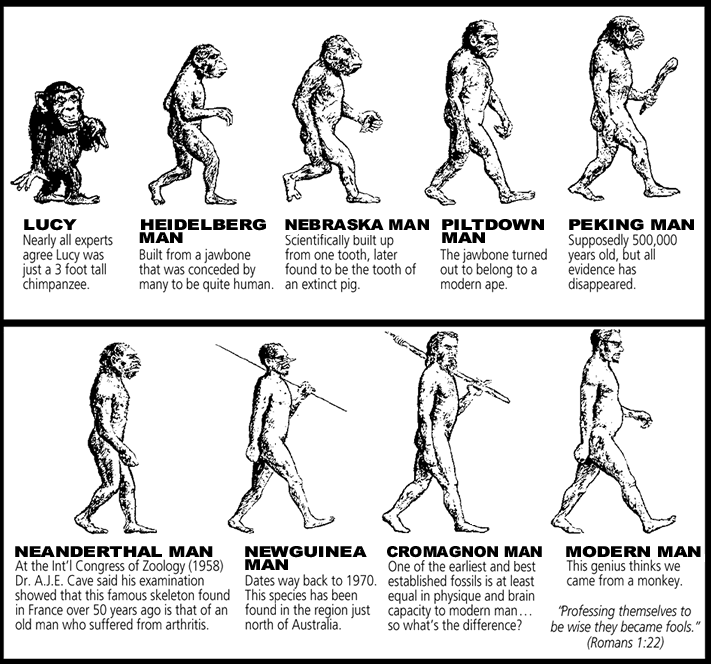
I respect Huckabee for making it clear that he does not believe it is his place to say who will make it to heaven and who won't; I also also respect him for saying that even though he does not believe in evolution it's not his place to impose his beliefs on others. However, he says that "that's the beauty of America" when stating that people are free to believe what they want- I think this is ironic, becuase he also says that the American people should know about his faith and what he believes in; clearly what believe religiously does matter. Personally, I find Huckabee to be somewhat irritating in this clip becuase he gets kind of annoyed while defending himself; if he came off more calm I think he would have had a stronger effect on the listeners. In terms of prayer in the classroom, having an allotted time for prayer seems just bizarre to me and contradictory to the entire idea behind separation of state and religion, but it doesn't sound like he wants to bring prayer back into the classroom or even grant a time for prayer. Becuase I very much believe in evolution, it just seems scary to me that a potential President of our country thinks that "we are not descendants of apes-" which, by the way, is a ignorant way of describing the evolutionary process- but the bottom line is that a vast number of people agree with him, and in many ways this could end up helping him. I just wish that religion did not play such a significant role in American politics...or that it just didn't play a role at all.

Wednesday, November 28, 2007

The Closet Athiest

http://www.geocities.com/closetatheist/evolutionclassroom.htm

I have not figured out exactly what I believe religiously at this time in my life, but I have to say that I fully agree with the statements this writer makes (the "Closet Atheist"). When Pat Buchanan sais that parents have a right to insist that Godless evolution not be taught to their children, or that their children "not be indoctrinated in it," the Closet Atheist responds with, "The irony that Pat Buchanan is concerned about children being indoctrinated is amusing. If schools are not going to indoctrinate children in science, perhaps they should also stop indoctrinating children in reading and math." Well said- I have nothing else to add to that comment.

When the Kansas Board of Education lost it's Christian majority in the November 2005 elections, evolution, the Big Bang Theory, and plate tectonics were all re-introduced into the state's science curriculum after having been removed from standardized tests a year and half earlier. First of all, how did these topics get removed to begin with? Do the American people want the next generation of children to be ignorant of scientific evidence about the world? We are already considered ignorant; when we don't want to teach our children science becuase it contradicts faith something is wrong. Faith is exactly that- faith. Religion has no true solid foundation; people choose to believe in it out of faith. How do you teach a curriculum based off of faith? You can't. As the Closet Atheist says, "It is no wonder that creationists fight evolution so aggressively. It is much more appealing (and easy) to believe that we are made in the image of a God. But as the saying goes: The truth hurts."

Religious Doctrine in the Science Classroom

http://www.adl.org/issue_religious_freedom/create/creationism5.asp

I was under the impression that the separation of church and state was enforced in the United States, but the more articles I read like this one the more disgusted (not to be harsh) I become that religion plays such a huge role in educational decisions. In Dover, PA, the school district became the first in the nation to allow for discussion of intelligent design in the science room. This was overturned, but in 2004, the school district's board of education adopted a revision to the highschool biology curriculum stating that “Students will be made aware of gaps/problems in Darwin’s Theory and of other theories of evolution including, but not limited to, Intelligent Design.” The November 2005 Kansas Board of Education decision "approved biology standards that characterized evolution as a flawed scientific theory and redefined science to include supernatural explanations, such as intelligent design, rather than natural explanations for physical evidence." In 1999, the Oklahoma State Textbook Committee said "that publishers doing business with the state be required to place a disclaimer in all biology books" stating that evolution is “a controversial theory which some scientists present as a scientific explanation for the origin of living things, such as plants and humans.” It also says that the evolutionary theory is an “unproven belief that random, undirected forces produced a world of living things.” The fact that these actually go into effect- that these concerns are actually awknowledged and put into law- really makes me wonder about people. Are people really so ignorant and close-minded that they think their religious beliefs are comparable to scientific evidence and should be taught to everyone regardless of differing religious and cultural backgrounds? It seems completely ridiculous to me, but I suppose as long as evolution is taught the American educational system has not completely strayed from its core values.

Tuesday, November 27, 2007

Poll: Creationism Trumps Evolution

http://www.cbsnews.com/stories/2004/11/22/opinion/polls/main657083.shtml

This poll, done by CBS News, found that the vast majority of Americans believe in creationism- or if not creationism, that God was involved in the process- compared to the minority 13% percent who believe that God was not involved at all. Although this is a poll and there is room for chance error, from what we learned in class the majority of Americans believe in God, and for most of those Americans they would most likely fall in the 87% who believe that in some way He was responsible for modern man. 67% of Bush voters believe that God created humans in their current form compared to the 47% of Kerry voters... 71% of Americans think that creationism should be included in school curriculum alongside evolution, and 71% of Bush voters and 56% of Kerry voters thought that as well. 60% of Evangelical Christians think that creationism should replace evolution altogether. These statistics show a couple things- one, that people who voted for Bush tended to be more religious than those who voted for Kerry; which is not surprising knowing that Bush was very forward about his religion during his campaign and Kerry was more subdued about it (not to mention that Bush was Evangelical). Secondly, these statistics show how Christianity has a huge influence on the American people and politics in general. I personally find these statistics frightening- it is truly scary that so many people believe that creationism should be taught alongside evolution or replaced altogether becuase creationism is not based on factual scientific evidence. What people want, then, is faith-based religious curriculum- the idea completely goes against the separation of church and state and what this country is supposedly so proud of- the freedom of religion. Religious books are not textbooks.

School Science Debate Has Evolved


http://www.usatoday.com/news/education/2004-11-28-schools-evolution_x.htm

"Part of the job of the public school system is to make professional judgments about what children ought to learn," says Jack Krebs, a teacher and vice president of Kansas Citizens for Science. "It doesn't make any sense to give equal time to all these other ideas that are vastly unsupported. It's misleading to kids." I completely agree with this statement. It is ridiculous to me that the nation is increasingly asking for more religion in education... but education is supposed to be based off of FACTS, right? I have no problem whatsoever with people believing in what they want to believe in as long as it is not being imposed upon others, but this is a belief system and when it is taught in the classroom it is doing just that. I understand that Christians believe that Creationism is a fact- but there is no scientific evidence to base it off of, and how do you teach a theory in a classroom where the only evidence to support it comes from religious books? This article says that in western Wisconsin a particular school district requires that alternative theories of evolution be taught, and in Ohio the state school board passed a measure encouraging the teaching of evolution and intelligent design. In 1987 the Supreme Court found that "teaching creationism in public schools violates the constitutionally guaranteed separation of church and state." It seems to me that this is increasingly being ignored... believe what you want to, but to me, religion- of any kind- has no place in public education at all.

Monday, November 26, 2007

Court Splits Abortion and Fetus Murder

http://www.nytimes.com/2007/11/23/us/23texas.html

I think that this case presents the ethical issue of abortions in a very real-life scenario: why is it okay for a fetus to be "murdered" if the women chose for it be, but not okay for a fetus to be murdered if someone killed the mother (and, therefore, obviously the fetus)? In Texas, abortions are legal, but if a pregnant women is murdered during any stage of her pregnancy the person is charged with both the fetus' and the mothers' murders. I think this is kind of a double standard- it's difficult becuase I want to say that Terence Lawrence should definetely be charged with two murders, but why then is it ok for a women to get an abortion just becuase she chose to? I'm not saying that abortion should be illegal, but it does make me question why I believe that, becuase the bottom line is that although a fetus is not living yet, it has the potential to live, and how is it not considered murder if you purposefully prevent a life from living? This article made me look at the issue from a different angle and caused me to realise the hypocrisy of the issue- the Texas court said that the abortion precedent was based on the premise that a women wants the procedure, but in not-so-nice-of-words that's basically saying that if a women chooses to kill the fetus then it's okay becuase she wanted to, but since she didn't ask for someone to murder her and therefore the child then it's not okay. Okay... so basically the point here is that as long as you ask for it it's okay? It just seems very ironic to me.

Planned Parenthood


http://www.plannedparenthood.org/birth-control-pregnancy/abortion-4260.htm

I found this description of abortion on the Planned Parenthood website very interesting because they portray abortion as if it were just another common medical procedure as if there were no ethical issues involved at all. Just the other day I was listening to a couple members of my family disagree on this issue exactly- one was saying that Planned Parenthood advertises abortion and portrays it as a positive solution to pregnancy, and the other was saying that it absolutely does not not do that, it simply offers abortions if someone so chooses to have one. I was agreeing with the opinion of the latter until I read this- although it does not straight out advertise abortions, it does portray them positively; although it is good that they make a point of the procedure being safe I do not think it necessary to elaborate on the history of it being a "common" procedure, not to mention portraying the outcome of Roe vs. Wade as being this great victory by concluding the paragraph with "today, abortion is legal nationwide and is one of the safest of all available medical procedures." The part that shocked me the most, however, was the last sentence- informing readers on where to find "information about the thousands of fake clinics that have been set up to frighten women away from choosing abortion." Frighten women away? This is almost comical; women should be frightened- they should be fully informed and aware of the decision they make and it shouldn't be portrayed as having them be "frightened away." It is ridiculous that they are portraying such an enormous decision that could have potentially enormous emotional consequences so nonchalantly.

Rudy Firmly Pro-Abortion


Although I actually do agree with Giuliani's stance on this issue, I think he comes off somewhat unstable- I agree in the sense that I too personally disagree with it, but I do not think that it is the government's place to impose laws on something that is deeply personal- the government already has too much of a say on what people can and cannot do, and something like abortion is a huge issue for the government to intervene in and outlaw altogether. However, Giuliani says that he would be in favor of supporting alternatives to abortion if there were any- such as adoption- but what does that mean? I am very much in favor of adoption as well, but to someone listening to that he may come off as a person ashamed of being pro-choice- a "soft" pro-choicer who wants to appeal to the other side of the issue as well. Although I too could be described as a "soft" pro-choicer, if I were in politics I would not say something such as being supportive of alternatives simply because the only legit alternative is adoption; everyone already knows and is aware of the option of adoption. That being said, I do think that his stance will appeal to many people, and I definitely do agree on there being restrictions on abortion like he says.

Friday, November 23, 2007

Abortion Controversy

http://www.abortioninfo.org/

This is a very interesting site becuase it shows the issue from both sides. It seems to be pretty clear that the writer's personal belief is abortion is wrong becuase she tends to show a bias towards the anti-abortion arguments, but the other side is presented and awknowledged; coming from a non-religious perspective it is sort of irritating to me that the anti-abortion viewpoints' main defense is "God." I am not religious, and although I do not think that abortion should be made illegal I personally would never get one; in defense to most of the questions she asks from the pro-abortion stance I would have answered with presenting alternatives such as adoption- which I think is underrated, becuase in order to adopt a family must be completely qualified and is truly in want of a child. Also, how about presenting abortion as a weak and pathetic way to deal with the choices you made? The one thing this site does say that I found interesting is that if abortion is not murder, then what is it? These are the sort of things that I think the issue should be presented as; not everything moral has to be linked to religion and the pro-life side should think of alternative ways to defend their position rather than simply pointing to God. If you choose to have sex then you have to be prepared for the consequences, period. It is not all fun and games. That is really what the issue should be.

Wednesday, November 7, 2007

Doctors and Med Students

http://www.lifedynamics.com/Abortion_Prolife/Abortionist_Info/


This site offers an interesting topic in relation to abortions- I personally had never even thought about abortionists outside the movie The Cider House Rules. It is interesting and meaningful that even people within the medical profession look down upon abortionists in the sense that clearly even people who describe themselves as pro-life do not look upon abortions lightly or positively. The fact that people within the medical profession are pushed to the abortionist field as a last resort also says something about the negative viewpoint of abortions. I don't even know what the solution to this is, becuase although I think abortions are horrible, I don't think they should be made illegal; where then is the solution to having more highly trained abortionists? Just tying that makes me cringe- it is very understandable why such a negative stigma is placed upon them becuase regardless of your stance on the issue when it comes down to it abortionists are preventing a life from being born, and that is certainly something that understandably not many people want to have anything to do with.